
Cardiff Met’s Rugby History
The Evolution of College Rugby
When Cardiff Training College opened in 1950 the facility base was a disused army barracks in Heath Park. These basic facilities, which included student hostel accommodation, were used to train teachers until the purpose-built Cyncoed Campus opened in 1963. The Heath facilities were used to accommodate and teach second year students until the class of 1971-74, who were the last residents.
The initial cohorts of students were recruited to fill workforce shortages in Physical Education and Art following World War 2. Cardiff Training College was designated a specialist “wing college” for Physical Education under the leadership of Eric Thomas and Syd Aaron. Many of the students recruited were mature students who had already completed National Service as conscripts.
The nature of these students meant that they took the lead role on organising sport fixtures with the support of the teaching staff. The teams were student led and there were no coaches in the early years – captains were in charge.
During the 1950’s the college was fighting to establish a reputation for high quality physical education teacher training and seek parity with the well-established colleges. Historically Welsh schools had a strong relationship with St Luke’s College, Exeter and Loughborough College and many Welsh Schools Rugby internationals went out of Wales to study.
The pattern changed after a certain Clive Rowlands was captain of the college for two years (1959 & 1960) and the college beat St Luke’s and Loughborough – the trend changed and the 1960’s and 1970’s saw a large number of international schoolboys choosing to train as PE teachers in Cardiff.
During the 1960’s three academic staff started to make a contribution to coaching the college rugby team – John Evans, Roy Bish and Leighton Davies. Roy Bish also coached Cardiff RFC and later moved to Italy to take up a coaching position.
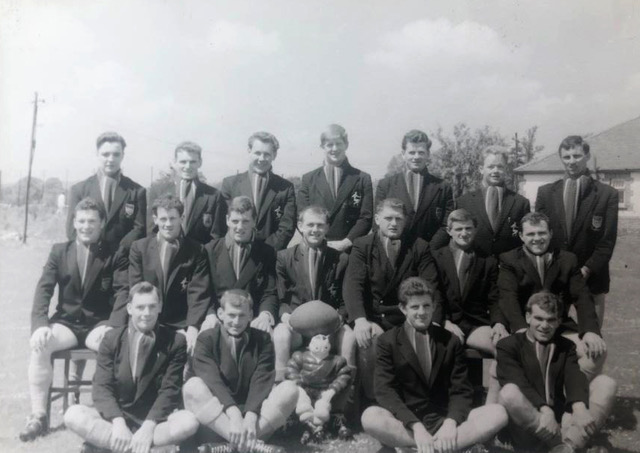
The late 1960’s saw Leighton Davies (Nutty Leight) ending his playing career as an open side flanker with Bridgend and Maesteg and focusing more on his coaching role at Cyncoed. Leighton worked tirelessly over and above his teaching duties to develop the rugby club at Cardiff College of Education. He found a great ally in Eifion Morgan, a science lecturer, who took on the role of fixture secretary. There were no official leagues in this era and all matches, with the exception of cup fixtures, were classified as “friendlies” – although the reception on a wet windy night in Abercynon or Lydney was rarely friendly! This situation allowed Leighton and Eifion to secure fixtures with many of the First Class/Merit Table clubs and clubs just over the Severn bridge, especially with the introduction of floodlights at many grounds in South Wales that allowed midweek evening games. By the mid-70’s the student numbers had grown and there were regularly three teams playing twice a week in term time.
Leighton’s reign as coach lasted 20 years until he took early retirement in 1989. The timing also coincided with the planned introduction of National Leagues in 1990, which will be covered later. Leighton believed in open, expansive, 15-man rugby based on fitness and skill. He also believed in exposing talented young players to the demands of the senior game in Wales. Countless college players who went on to play first class and international rugby owe a great deal to the Nutty Leight factor. Players such as Sir Gareth Edwards, John Devereux, David Bryant and Justin Thomas won their first international caps while they were still students. In the case of John Devereux, he didn’t take any of his degree examinations in Cardiff – during his second year he sat his exams while he was on tour with Wales in the South Seas and in his final year he was on tour with the British Lions!!
Outside of friendly fixtures, Cardiff College/South Glamorgan Institute/Cardiff Institute played in the British Colleges Cup and the WRU Cup competitions. There were some memorable WRU Cup encounters with first class opposition such as Cardiff RFC, Newport RFC and Pontypool RFC.
Cardiff College/South Glamorgan Institute/Cardiff Institute teams were very successful in the British Colleges Cup competition which started in the early 1970s, winning the cup on numerous occasions.
Up until the 1990’s, higher education in the UK was based on a tripartite system with Universities, Polytechnics and Colleges, and each had their own competition structures. Therefore, there were very few matches between colleges like Cardiff and universities like Loughborough and Durham. The three organisations – the UAU, British Polytechnics (BPSA) and British Colleges (BCSA) – merged in the early 1990’s to form BUSA (British Universities Sports Association). This reflected the conversion of all higher education establishments to University status. In our case, Cardiff Institute of Higher Education became UWIC (University of Wales Institute Cardiff).
The early 1990’s saw two major changes that impacted on the rugby club at Cyncoed : the merger of the HE sports competitions under a single banner of BUSA (British Universities Sports Association) and the formation of the National Leagues by the WRU and RFU. The BUSA initiative was seen as a great way forward in building one of the largest sport competitions in the world, with over 100 institutions competing in 40+ sports at a multitude of levels.

On the other hand, the formation of the National Leagues signalled a potential death nell for college rugby as we knew it. The potential for arranging friendly matches against first class clubs was greatly reduced and the college side had the go through a “play-off system” to establish where we would be placed in the new League structure. The outcome was that the college lost out to established clubs – Llanharan, Rumney and St Peters – and were destined to compete in the East District leagues on Saturdays rather than the National League.
This change coincided with Leighton Davies deciding to take early retirement from his post and left the college rugby club at a major crossroads – take up the option of Saturday rugby in the East District league programme or abandon Saturday rugby and just play on Wednesdays like most other universities in the UK? Leighton had clearly expressed his view by retiring.
Enter David Martin and the Pugh brothers – Dr John Pugh, recently appointed as the Dean of the Faculty of Education, and Vernon Pugh QC, the Chairman of the WRU and soon to become the Chairman of the IRB (World Rugby), who transferred their allegiance from Cardiff HSOB to coaching the college. David Martin, who was a Senior Manager in charge of Corporate Services/Finance, was determined to keep Saturday rugby alive and persuaded John Pugh to coach the 1st team. The college won the East District in successive years but lost in the play-offs to Tonmawr and Cardiff HSOB before finally gaining promotion through to the National Leagues in 1993 – further promotions followed and in 1996 the squad won promotion to National Division 1 and won the BUSA Championship against Loughborough at Twickenham! The Saturday side subsequently formed part of a National Division (East and West) and then the National Championship as we know it today, regularly finishing in the top half of the table. Following the sad early death of Vernon, John was supported on the coaching front by John Lloyd, John Huw Williams and Allan Martin.
Coaching duties passed on to Steve Williams and Paul “Joey” Evans (1998/99) before the internal support infrastructure for rugby was strengthened by John Pugh/Dave Cobner with the creation of a Director of Rugby role in the School Of Sport. The first post holder was Geraint John (1998-2000), who was succeeded by Kevin Bowring (1998-2001) and then Chris Davey (2002-2018). Dr Danny Milton then took over and lead the club through to 2024.
Playing competitive rugby on Wednesdays and Saturdays was a challenge for the players and the coaching staff with the first team squad committed to 40-50 fixtures per season. On the BUSA front, although we won the Championship in 1996, it was not plain sailing in the early years because the initial regional structure meant that the college (UWIC) played the first stages of the competition within Wales and there were too many mismatches at all levels, with UWIC 1st and 2nd teams winning by very large margins. On the positive side, UWIC 2nd XV (the Emerging XV) were in 7 National BUSA Finals in 12 years, winning 5 titles. In 2003 UWIC won 1st XV, 2nd XV and 3rd XV titles on the same day!!
The issue of mismatches in many sports was addressed by a group called the Directors of Sport Forum (Dave Cobner as Secretary), with members from the top sporting Universities in the UK, who pushed for the establishment of a super league with block fixtures in a range of sports. BUSA responded by establishing a more national approach and merit-based leagues that allowed the best 2nd and 3rd teams to play first teams from other Universities. These changes also led to the creation of Premier League North and South which sat above the regional conference leagues, with UWIC playing regular fixtures against Exeter, Bath, Hartpury, Bristol, Imperial Medics and occasionally Cardiff and Swansea. This was a major step forward in providing challenging fixtures on a weekly basis, but there was still concern that major forces in University Rugby such as Cardiff Met and Exeter would only play strong Northern Universities such as Durham and Loughborough if they were drawn as opponents in the National knock-out rounds.
In 2008 BUSA was restructured again through a merger with University and Colleges Sport (UCS) to form BUCS with the intention of further streamlining University sport and recreation services. Each major sport had a Senior Management Group drawn from BUCS staff and senior managers and coaches from across the sector. Dave COBNER (Chair) and Chris Davey (Coach) were members of the group that created what is now called BUCS Super Rugby – a genuine National League for the top 10 rugby universities in the UK. Initially set up with 8 teams (7 English Universities + Cardiff Met), the league has grown to 10 teams currently including three Welsh Universities, which is good news for Welsh Rugby.

The creation of the National Super Rugby League brought additional challenges for Cardiff Met RFC to overcome – very strong opposition and long-distance travel on a regular basis. The management and balancing of physical preparation with game preparation/recovery has led to a one game per week strategy and Cardiff Met creating a 50 strong first team squad to cover the demands of BUCS Super Rugby and the Welsh Premiership League programme. Chris Davey led the programme with the support of Dai Manley and Dan Milton for 15 years before being succeeded as Director of Rugby by Dan Milton in 2018. Ian Gardner was also appointed to the academic staff and transferred his coaching commitment from Bedwas RFC to Cardiff Met RFC, becoming Head Coach in 2018/19.
The Cardiff Met rugby programme is set up as an academy to maximize the rugby and academic development of the students. There is outstanding strength and conditioning provided by Dai Watts and his team, excellent coaching provided by a team of 16 coaches and strong support services such as performance analysis and physiotherapy. The programme is clearly working because we are regularly producing professional rugby players who were never in a club academy system before coming to Cyncoed – Tom Pearson, Luke Northmore and Alex Dombrandt were all selected by Eddie Jones to be part of the England squad in 2022.
On the participation front the club is unrecognisable from the set up in earlier decades. In addition to our senior sides, in recent years before COVID-19 we had very successful Youth teams that won the Welsh Youth Cup in successive years.
In 2024/25 the club has 8 teams in the BUCS competition structure and fields 3 teams on Saturdays in the Admiral Premiership, Division 6 East Central and in the East District Premiership.
In recent times the rugby programme has developed a strong working partnership with Cardiff Met Sport, with the University appointing a Director of Rugby, a full time physiotherapist and a full time skills coach to support the large player base.
Over the past seventy five years, rugby in Cyncoed has never stood still and we continue to evolve into our eight decade, developing University rugby and adding value to the student experience and the local community.
Onward and upward !!
Dave Cobner, Cardiff Met RFC Chairman
Cardiff Met Internationals
| NAME | COLL YEARS | COUNTRY | CAPS | LIONS | RWC |
| Haydn Morris | 1951 – 1952 | Wales | 3 | 55 | |
| Denzil Thomas | 1951 – 1952 | Wales | 1 | ||
| Ray Williams | 1951 – 1952 | Wales | 3 | ||
| C Lyn Davies | 1952 – 1953 | Wales | 3 | ||
| Geoff Whitson | 1952 – 1955 | Wales | 3 | ||
| Bill Morris | 1955 – 1956 | Wales | 3 | ||
| Billy Watkins | 1955 – 1956 | Wales | 1 | ||
| David Nash | 1958 – 1960 | Wales | 6 | 62 | |
| *Clive Rowlands | 1958 – 1960 | Wales | 14 | ||
| John Davies | 1959 – 1962 | Wales | 1 | ||
| Dewi Bebb | 1960 – 1961 | Wales | 34 | 62 (2) & 66 (6) | |
| Tony Gray | 1961 – 1964 | Wales | 2 | ||
| *John Lloyd | 1962 – 1965 | Wales | 24 | ||
| Keri Jones | 1963 – 1966 | Wales | 5 | 68 | |
| * Brian Price | 1965 – 1966 | Wales | 32 | 66 (4) | |
| John Jeffrey | 1965 – 1968 | Wales | 1 | ||
| *Gareth Edwards | 1966 – 1969 | Wales | 53 | 68 (1) & 71 (4) | |
| Robert Morgan | 1966 – 1969 | Wales | 9 | ||
| Clive Shell | 1967 – 1970 | Wales | 1 | ||
| J J Williams | 1967 – 1970 | Wales | 30 | 1974 (4) & 77 (3) | |
| Allan Martin | 1968 – 1971 | Wales | 34 | 1977 (1) & 1980 | |
| Roy Bergiers | 1969 – 1972 | Wales | 11 | 1974 | |
| John Bevan | 1969 – 1972 | Wales | 10 | 1971 (1) | |
| Colin Smart | 1960 – 1961 | England | 17 | ||
| Brynmor Williams | 1970 – 1973 | Wales | 3 | 1977 (3) | |
| Stuart Lane | 1971 – 1974 | Wales | 5 | 1980 | |
| Clive Griffiths | 1972 – 1975 | Wales | 1 | ||
| Les Keen | 1973 – 1976 | Wales | 4 | ||
| David Richards | 1973 – 1976 | Wales | 18 | 1980 (1) | |
| Gareth Williams | 1974 – 1977 | Wales | 5 | 1980 | |
| Rhodri Lewis | 1978 – 1981 | Wales | 7 | ||
| Kevin Hopkins | 1980 – 1984 | Wales | 7 | 1987 | |
| John Devereux | 1984 – 1987 | Wales | 21 | 1989 (1) | 1987 |
| David Bryant | 1987 – 1990 | Wales | 8 | ||
| Tony Copsey | 1987 – 1990 | Wales | 16 | ||
| Stuart Davies | 1989 – 1992 | Wales | 17 | 1995 | |
| *John Humphreys | 1989 – 1992 | Wales | 35 | 1995 & 99 | |
| *Paul John | 1989 – 1992 | Wales | 10 | ||
| Matthew Back | 1990 – 1994 | Wales | 4 | ||
| Justin Thomas | 1992 – 1995 | Wales | 9 | ||
| Geraint Lewis | 1995 – 1997 | Wales | 16 | 1999 | |
| Ben Evans | 1995 – 1998 | Wales | 27 | 1999 | |
| Nathan Budgett | 1995 – 1998 | Wales | 12 | ||
| Gareth Cooper | 1997 – 1998 | Wales | 46 | 2005 (1) | 2003 & 07 |
| Gareth Williams | 1997 – 2000 | Wales | 9 | ||
| Steve Jones | 1997 – 2001 | Wales | 5 | ||
| *Ryan Jones | 1997 – 2001 | Wales | 75 | 2005 (3) | 2011 |
| T Rhys Thomas | 2000 – 2003 | Wales | 27 | 2017 | |
| Dominic Day | 2004 – 2007 | Wales | 3 | 2015 | |
| Aaron Shingler | 2006 – 2009 | Wales | 27 | 2019 | |
| Mike Dias | 2006 – 2010 | Portugal | 2 | ||
| Ken Owens | 2006 – 2007 | Wales | 91 | 17 (2) & 21 (3) | 2011, 15 & 19 |
| Kieran Marmion | 2008 – 2009 | Ireland | 28 | ||
| Alex Cuthbert | 2009 – 2010 | Wales | 57 | 2013 (1) | 2015 |
| Sam Cross | 2010 – 2013 | Wales | 2 | ||
| Dawid Rubasniak | 2019 – 2019 | Poland | 4 | ||
| Aaron Wainwright | 2015 – 2017 | Wales | 55* | 2019 | |
| Alex Dombrandt | 2015 – 2018 | England | 20* | ||
Sevens Internationals
Wales first played in an international Sevens tournament in 1973 to help celebrate the Scottish Rugby Union’s Centenary.
JJ Williams, Gareth Edwards and Ian Lewis were in the Welsh squad that reached the semi-finals. Wales has competed at the Commonwealth Games since sevens was first introduced in Kuala Lumpur in 1998. Gareth Cooper was in the 1998 squad, Alex Cuthbert, Aaron Shingler and Lee Williams played in 2010, Lee Williams again in 2014 and Owen Jenkins in 2018.
Richard de Carpentier and Dan Bibby won bronze medals with England at the 2018 Commonwealth Games. Richard was also in the England squad that finished runners-up at the 2018 World Cup.
Wales won the 2009 Rugby World Cup Sevens title in Dubai and Lee Williams and Aled Thomas played in the winning Welsh side. Paul John was the coach and also coached Wales in 2013 and Hong Kong in 2018. Dai Rees was the Hong Kong coach in 2013.
Darren Edwards played for Wales at the 1997 World Cup, Lee Williams was captain in 2013 and Owen Jenkins played in 2018. At the 2016 Olympic Games, Dan Bibby and Sam Cross helped Team GB to win the silver medal.